After 85 Years: Claude and Astra Crack Unread WWII Enigma Messages
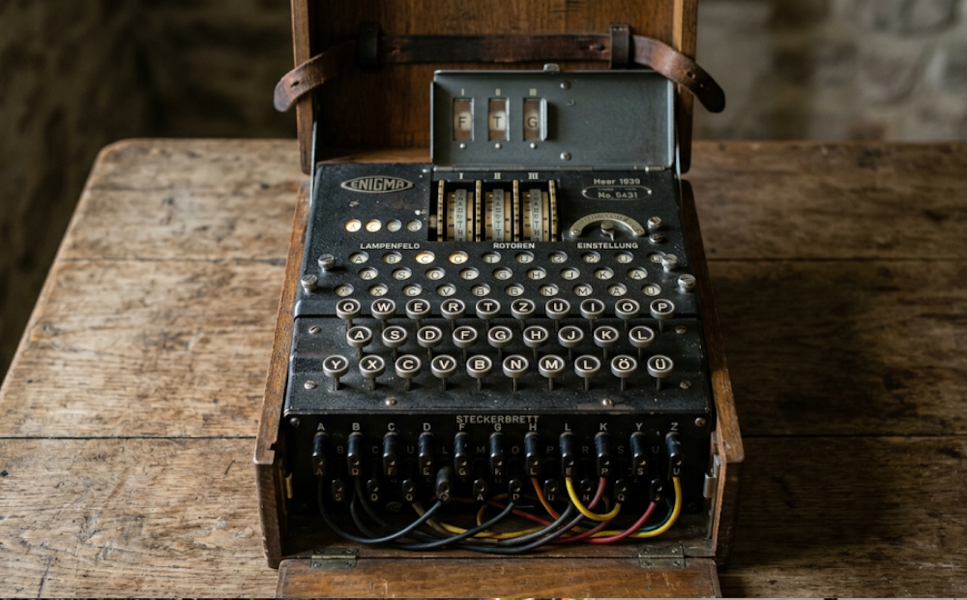
During World War II, Germany relied on the Enigma machine to encrypt its military communications. The device used complex mechanical configurations—such as rotor arrangements and plugboard connections—that changed with every keystroke. Because the machine was designed to be reversible, decoding a message required the receiving party to know the exact settings used at the moment of encryption.
The primary challenge has always been isolating the correct configuration from millions of possibilities. In September 2026, researcher Carter Levin used the AI model GPT-6 Astra to decipher German message No. 172 (indicator MVUEH). Sent on July 10, 1941, the message had remained unsolved for decades. The model compared this mysterious text to a previously cracked message from the same day and intelligently deduced that a location name, "ROSENOW," was likely present in the unsolved message as well. Using this word as a crib (a known segment of plaintext), Astra built an Enigma simulator to test configurations. It systematically eliminated any setting that failed to produce the word, eventually discovering the correct setup and decoding the entire message.
Roughly six days later, on September 20, 2026, researcher Jack Willis used another AI model, Claude Opus 5, to crack a second text: message No. 285 (indicator FMNGI), dated July 31, 1941. This attempt involved more direct human guidance. Willis provided the model with pre-built cryptographic analysis tools and a highly robust crib: the signature of German officer Friedrich Hartjenstein, formatted as XHARTJENSTEINX. Applying the same logical approach, the model rapidly searched for settings that translated the ciphertext into this signature, discarding the rest. It successfully broke the cipher in just about 13 minutes.
This methodology—guessing a plaintext word and eliminating incompatible settings—is the exact historical technique developed by mathematician Alan Turing during WWII to defeat the Enigma. While the foundational concept has been understood for decades, these specific messages remained unbroken for two reasons: the sheer difficulty of guessing an accurate crib for isolated historical texts, and the immense computational time and effort required to verify the results. Artificial intelligence bridged this gap by automating the verification process, testing millions of permutations in record time without continuous human oversight.
Ultimately, the core difference between the two breakthroughs lies in the AI's level of autonomy. GPT-6 Astra, working alongside Levin, operated completely independently; it inferred the crib (ROSENOW) from context and coded its own search tools from scratch. Conversely, Claude Opus 5, directed by Willis, functioned as a hyper-fast executor, relying on pre-existing tools and a precise crib supplied by its human operator to arrive at the solution.