After Russia, the UK Brings Horses Back to the Battlefield
Although horses remain in service with some armies today, they are no longer used on battlefields. Instead, they are typically reserved for official ceremonies, and occasionally for surveillance, search, and patrol missions. Their use in modern warfare had largely ended after tanks, military vehicles, and aircraft replaced them on the front lines. It remained difficult to imagine the horse returning to the vanguard in an era of precision weapons and drones, until the war in Ukraine began bringing some ancient methods back into the picture.
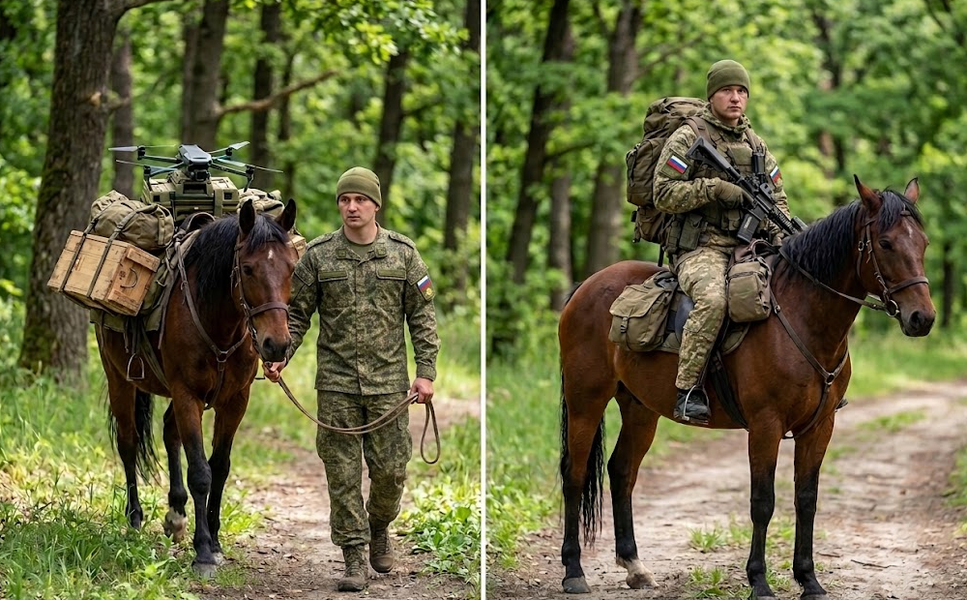
Russia has reintroduced the use of horses and donkeys on certain war fronts in Ukraine, specifically to transport supplies and soldiers near the front lines. They have also been seen carrying mobile communication devices. Russian forces resorted to using them to counter the heavy deployment of Ukrainian drones, which can easily detect and target vehicles moving near the front.
Ukrainian drones monitor vehicle movement both visually and thermally, as vehicle engines and exhausts emit heat. Moreover, vehicles typically move along limited roads and paths that can be easily monitored and targeted. Horses, on the other hand, can move off-road, through trees, and across rugged terrain, and they lack the distinct thermal signature of motor vehicles. Furthermore, spotting a horse from the air in a rural or forested area might not draw the same attention as a military vehicle, making their use more practical in certain regions.
Notably, this concept has not remained confined to Russia alone. In the UK, according to The Times, soldiers from the Royal Cavalry conducted exercises during the summer of 2026 in the Longmoor area of Hampshire. These included camouflage trials using nets designed for horses, alongside training in horseback reconnaissance, navigation, and movement across difficult terrain.
The exercises were not merely an equestrian showcase; they involved testing the soldiers' ability to execute reconnaissance and movement missions in environments where vehicles might be less optimal. The troops also received training in equine first aid, preparing for the potential use of these animals in future military roles.
Thus, it seems horses are not returning to compete with tanks or armored vehicles, but rather to fill niche roles dictated by the nature of modern warfare. In forests, rugged terrains, or environments where fuel and vehicles become easy targets for drones, an animal once viewed as a relic of military history can offer a simple yet highly useful capability for mobility, transport, and reconnaissance.
This paradox may be one of the strangest lessons of modern warfare: as technology becomes more advanced, older methods do not necessarily disappear. Instead, they can return to the forefront when they provide an advantage that modern technology cannot easily offer. Drones, thermal systems, and advanced reconnaissance equipment have transformed the battlefield, but at the same time, they have pushed armies to seek simpler, less conspicuous means of movement.
Related Articles