Claude's Intelligence Develops an Autonomous Control System to Correct Quantum Computer Lasers Without Human Intervention
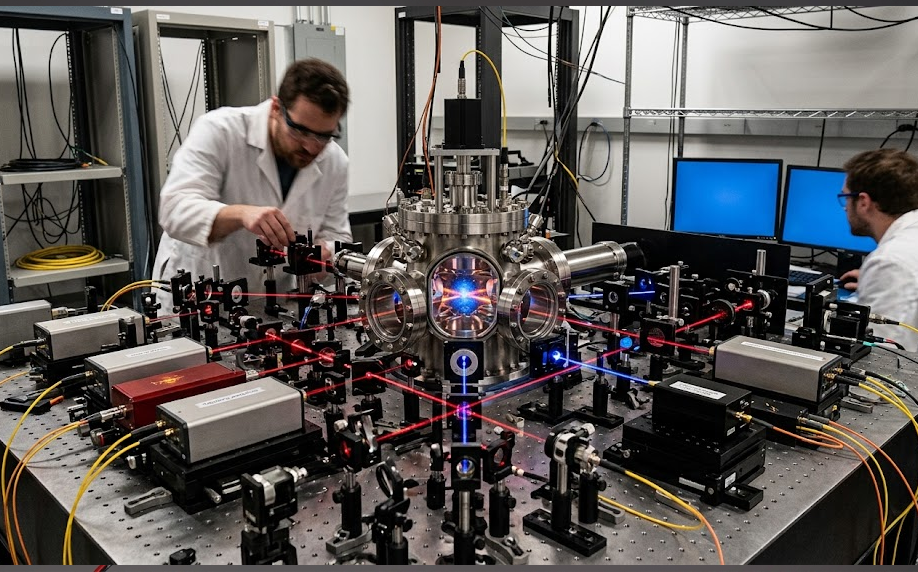
Quantum computers based on neutral atoms operate through a network of lasers used to control the quantum states of atoms and perform computational operations. These lasers must be precisely tuned to specific frequencies, and even a tiny deviation in frequency or intensity can disturb the atoms, destabilize the system, and immediately halt its calculations.
However, lasers are prone to frequency drift caused by slight changes in temperature, vibration, or electronic noise. When this happens, the quantum computer stops functioning and requires a human expert to manually recalibrate it through a long sequence of tests and measurements. This process can take several minutes, demands high expertise, and remains one of the most persistent daily challenges in operating such systems.
Anthropic, in collaboration with QuEra — a company specializing in quantum computing — used the Claude AI model to build a control program capable of handling laser adjustments as a human expert would, but faster and automatically. The model was given the ability to interact with a quantum computer in a secure environment to learn the logic of operation on its own. It began by experimenting with different settings, measuring the laser’s response, and analyzing drift signals, then refining its algorithm based on the results. After hundreds of repetitions, the model learned the subtle patterns that indicate the onset of drift and how to correct it with the fewest possible steps.
The outcome was a program able to recalibrate the laser within seconds — often in less than six seconds — with a success rate exceeding 695 out of 700 attempts, a task that typically takes a human expert around ten minutes.
Most importantly, the knowledge Claude acquired was not limited to a single laser. After succeeding with the first, it was transferred to a second laser with different characteristics, such as spectral linewidth, noise level, and drift behavior. Despite these differences, the model quickly adapted, though it required several initial attempts before reaching the same performance level. This demonstrates that the model did not memorize fixed steps but learned the underlying principle of control, enabling it to generalize its expertise across different devices.
With this advancement, quantum computers that rely on lasers can now operate without the constant presence of a human expert in the lab, bringing the field closer to self-maintaining quantum systems capable of handling operational faults automatically.
Report available on QuEra’s website.