Gemini 4 Argon Controls Spot Robot to Toss a Can into a Trash Bin
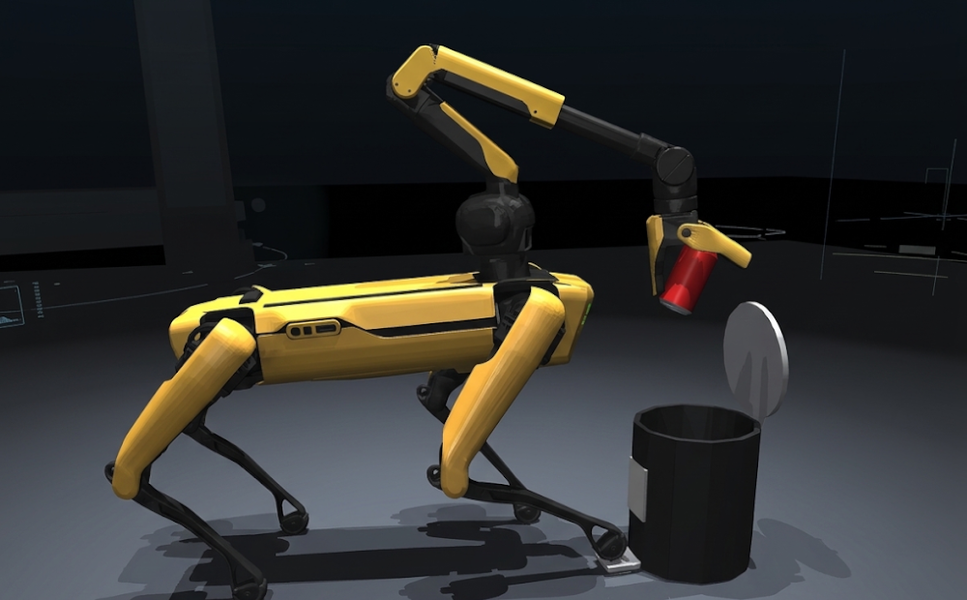
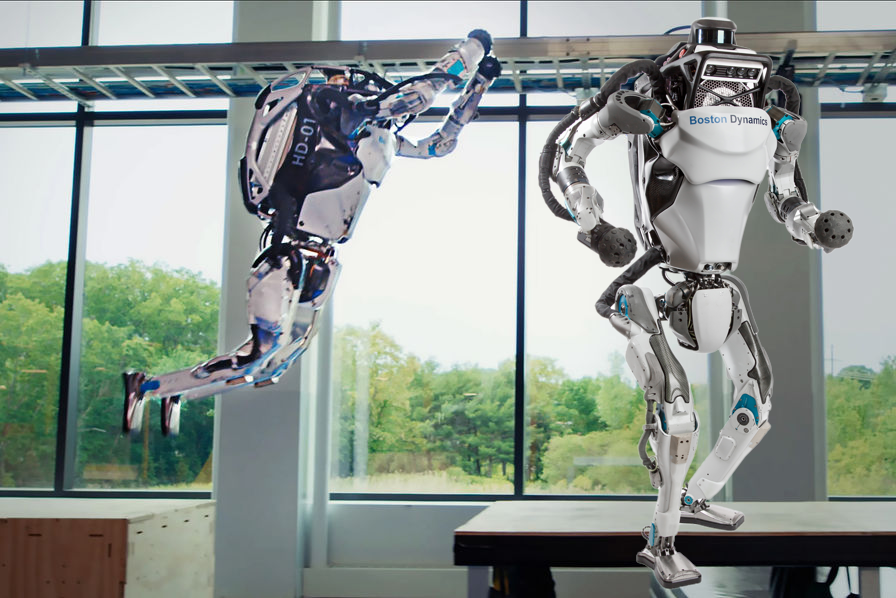
Google showcased the use of its latest model, Gemini 4 Argon, to directly control Boston Dynamics' four-legged robot, Spot. Argon guided the robot to complete a complex physical task: throwing a soda can into a foot-pedal trash bin.
The difficulty of this task lies in the fact that the robot will inevitably lose its balance when it lifts one of its feet to step on the pedal. Therefore, Argon had to calculate the exact balance point to keep the robot stable while standing on just three legs. This required reorienting and coordinating the multiple joint angles in the robot's legs, while simultaneously directing its robotic arm to extend and drop the soda can into the bin without disrupting its center of gravity.
To achieve all this, the process began with a text prompt asking Argon to have the robot pick up the soda can and throw it into the black pedal bin. The model immediately began planning the operation. First, it relied on cameras to capture an image of the surrounding environment. Then, it built a virtual "digital twin" using the MuJoCo physics simulation engine to perfectly match the physical bin and pedal. Within this simulation, the model performed "three-legged balance" calculations to ensure Spot could lift its foot to press the pedal while maintaining complete stability as it extended its arm.
To ensure no errors occurred in the real world, the request included the creation of two AI agents for dual visual verification. The first agent monitored the foot's movement through the lower cameras to ensure it was perfectly centered on the pedal before stepping. The second agent monitored the arm's movement to ensure its 3D alignment was directly above the bin's opening before giving the release command.
Thus, Argon didn't just send a blind, pre-calculated motion path for the robot to execute all at once; instead, it acted as a real-time performance supervisor. The model issued the initial execution command, and the robot picked up the soda can, pressed the pedal, and positioned its arm over the bin. At that critical moment, the monitoring agent discovered through live image analysis that the arm wasn't precisely in the right spot. Argon immediately adjusted the arm's position and orientation in real time until the alignment was perfect, after which the robot successfully dropped the soda can following this visual confirmation.
Through this approach, Argon went beyond being a mere model that only performs precise preliminary calculations, becoming an integrated control system that monitors the robot during execution and corrects real-time errors that could cause the task to fail.
This development represents an important leap in the world of physical AI, proving the ability of modern models to bridge the gap between the virtual world and physical reality. It paves the way for a future where robots interact with our complex environments with human-like flexibility and intelligence, without the need for manual programming, pre-training, or human intervention at every step.
Related Articles