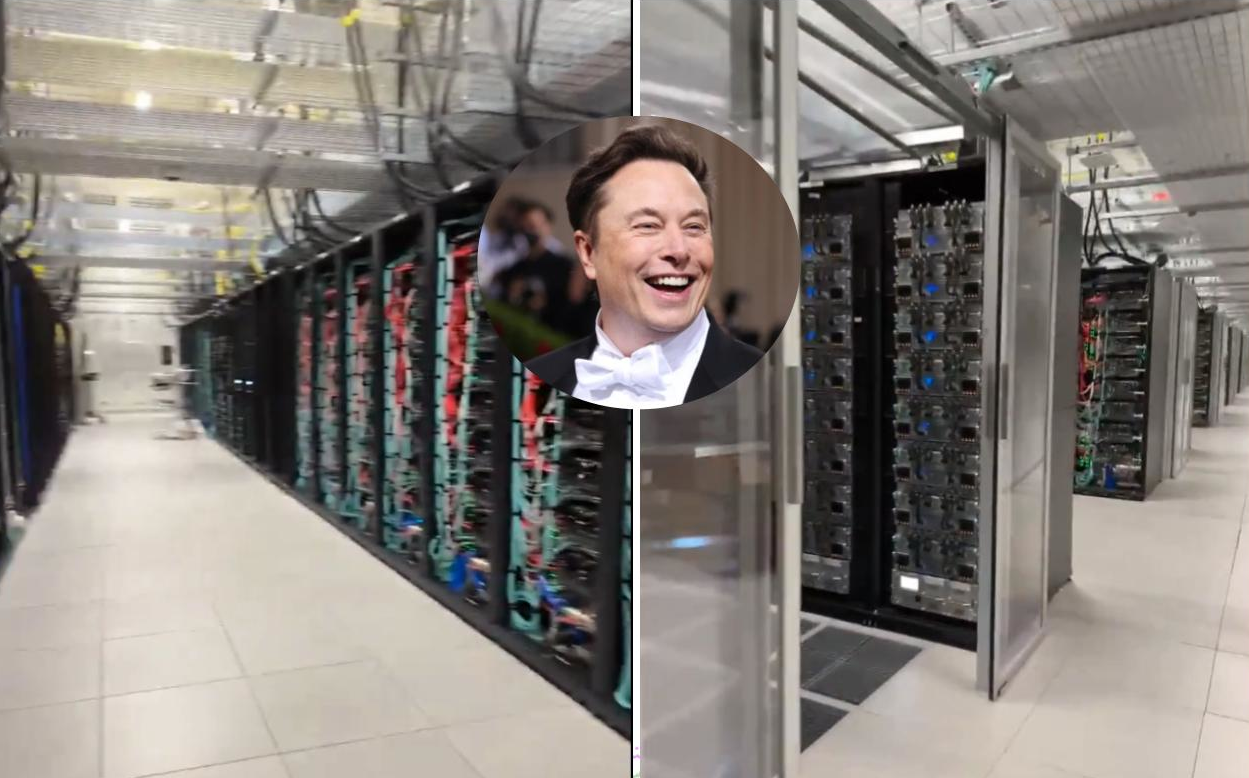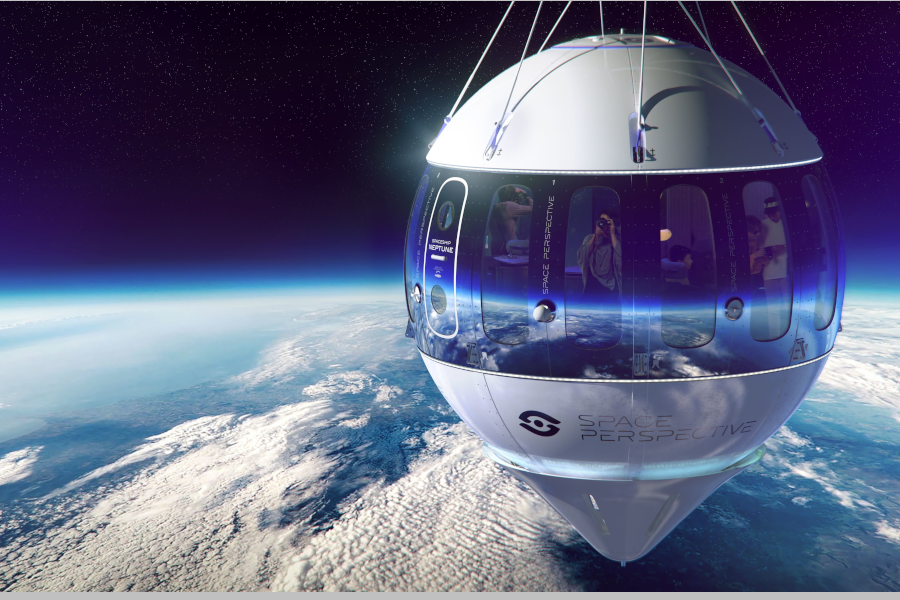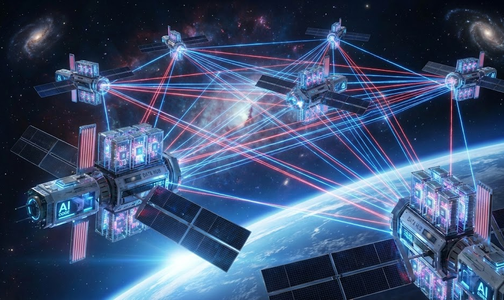
According to remarks made in several interviews, most recently at the 2026 Davos Forum, Elon Musk plans to build AI data centers in space and operate them via satellites. Musk’s reasons for this approach are neither exploratory nor research-oriented; rather, they are purely engineering and economic, aiming to solve the two biggest obstacles currently facing AI development: energy and cooling.
Regarding energy, Musk views space as the ideal power station, where solar panels operate with stunning efficiency that far exceeds that on Earth. The first reason is that space is always sunny; there is no day-night cycle, no clouds, and no weather fluctuations to halt production.
The second reason is the absence of an atmosphere. On Earth, the atmosphere scatters sunlight and absorbs part of it, whereas in space, you immediately gain 30% more energy due to the lack of this barrier. By combining the time factor (constant brightness) with the intensity factor (absence of atmosphere), Musk asserts that a single solar panel in space produces five times the energy of the same panel in the best location on Earth. Since AI models are incredibly power-hungry, space offers a sustainable source with maximum efficiency.
The second reason is free cooling. It is well known that AI chips generate immense heat during processing. Cooling them on Earth requires expensive infrastructure that consumes vast amounts of water and electricity. In contrast, space provides a natural and highly effective cooling system; temperatures in shaded areas drop to just 3 Kelvin (about -270°C), a temperature approaching absolute zero.
Musk explained the engineering mechanism simply: solar panels are angled toward the sun to generate power, while the servers' thermal radiators are pointed in the opposite direction, toward dark, cold space. This dissipates heat effectively without wasting any additional resources.
Thus, Musk arrives at an inevitable economic conclusion: "The lowest-cost place to put AI will be space." By combining multiplied solar energy with free natural cooling, the equation becomes intuitively profitable. The only remaining hurdle for humanity is overcoming the initial launch costs to make this future a reality.