Chinese Innovation Boosts Perovskite/Silicon Tandem Solar Cell Efficiency to 34%
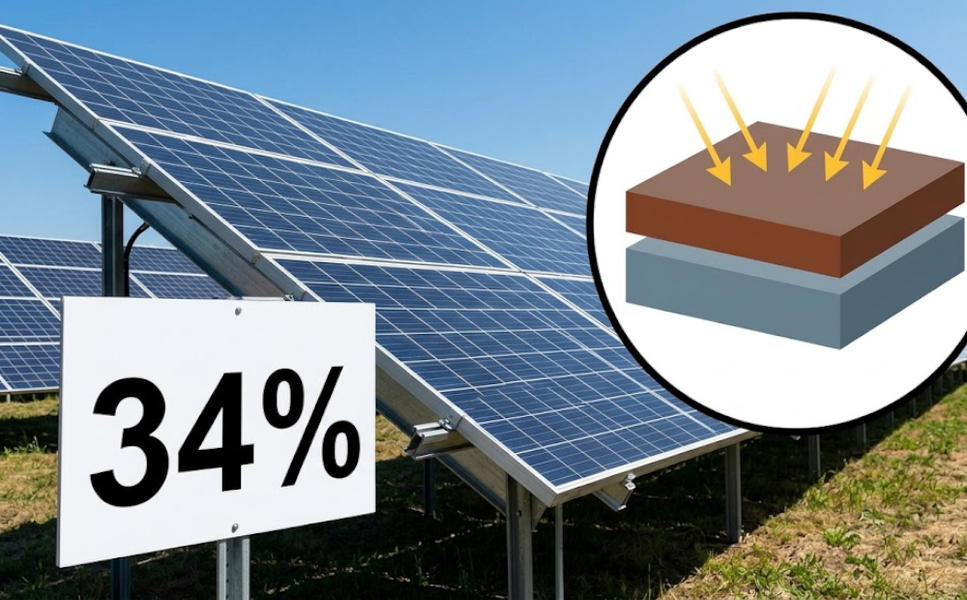
Researchers at Soochow University in China have developed a perovskite/silicon tandem solar cell that achieved a record power conversion efficiency of 34.0%. It also recorded a voltage of 2.014 V, one of the highest values ever reported for this type of cell.
To separate the perovskite and silicon layers, the researchers utilized zirconia nanoparticles. This approach improved the cell's performance compared to previous methods, which tended to slow down the movement of electrons between the perovskite and silicon layers, consequently reducing efficiency.
The cell was sent to an independent, third-party laboratory for testing, which certified a steady-state efficiency of 33.5%. This represents the true, sustained efficiency of the cell during continuous operation, rather than just its initial peak performance. This milestone was accompanied by a recorded voltage of 2.014 V, ranking among the highest ever recorded for such cells.
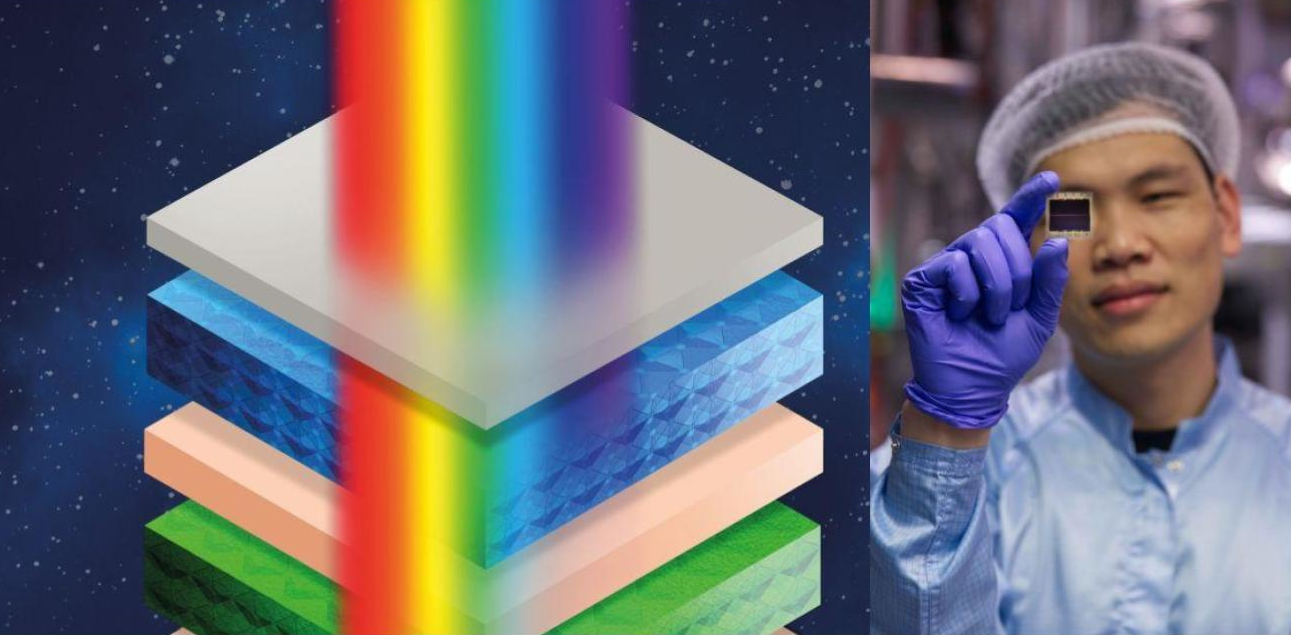
The concept of tandem cells relies on integrating two layers that work together to absorb as much solar energy as possible. The top layer, made of perovskite, is responsible for absorbing high-energy visible light, such as blue and green wavelengths. Meanwhile, the bottom layer, made of traditional silicon, captures the lower-energy red and infrared light that passes harmlessly through the top layer. This dual design enables the cell to utilize the solar spectrum much more efficiently than conventional single-junction silicon cells.
Despite these advantages, scientists have faced a major challenge at the junction, or interfacial layer, between the top layer and the rest of the cell. When the liquid perovskite precursor is applied to form the top layer, it often distributes unevenly and leaves voids. Worse still, the electrical charges generated by the cell tend to get trapped and lost at this interface before they can be extracted to generate electricity. Previous attempts to prevent this charge loss ended up slowing down the flow of electricity within the cell instead of solving the problem efficiently.
To overcome this obstacle, the researchers devised a precise solution using microscopic particles called "zirconia nanoparticles," scattering them at the interfacial layer directly beneath the perovskite. Instead of using a continuous insulating layer that would obstruct the flow of electricity, these dispersed particles acted as a "smart network" performing two crucial functions simultaneously. First, they smoothed and prepared the surface, helping the perovskite spread evenly to form a dense, flawless layer without voids. Second, they acted as a smart traffic barrier, preventing electrical charges from being lost at the junction while leaving wide pathways between the particles for electricity to flow smoothly and rapidly out of the cell.
Thanks to this clever modification at the interface, the cell not only achieved record efficiency and voltage levels but also demonstrated exceptional durability and a long lifespan. The cell was tested under continuous simulated sunlight at its maximum power point for 2,000 consecutive hours. Remarkably, it retained 84% of its initial efficiency after this period, proving that this technology is both highly efficient and stable, paving the way for widespread commercial use in the future.
The study was published in the journal Science Bulletin.
Related Articles