Researchers Develop a System That Turns Waste Heat Into Cooling Without Electricity
Cooling systems typically consume significant amounts of electricity, but that could soon change. Researchers at the Karlsruhe Institute of Technology (KIT) in Germany and the University of Tsukuba in Japan have developed what they describe as the world’s first solid-state cooling system powered by heat itself rather than electricity.
The innovation is based on a simple but potentially transformative concept: using ambient or waste heat — such as heat generated by electronic devices or sunlight — to produce mechanical motion, and then converting that motion directly into cooling. The approach could open a new path toward reducing energy consumption and lowering harmful emissions.
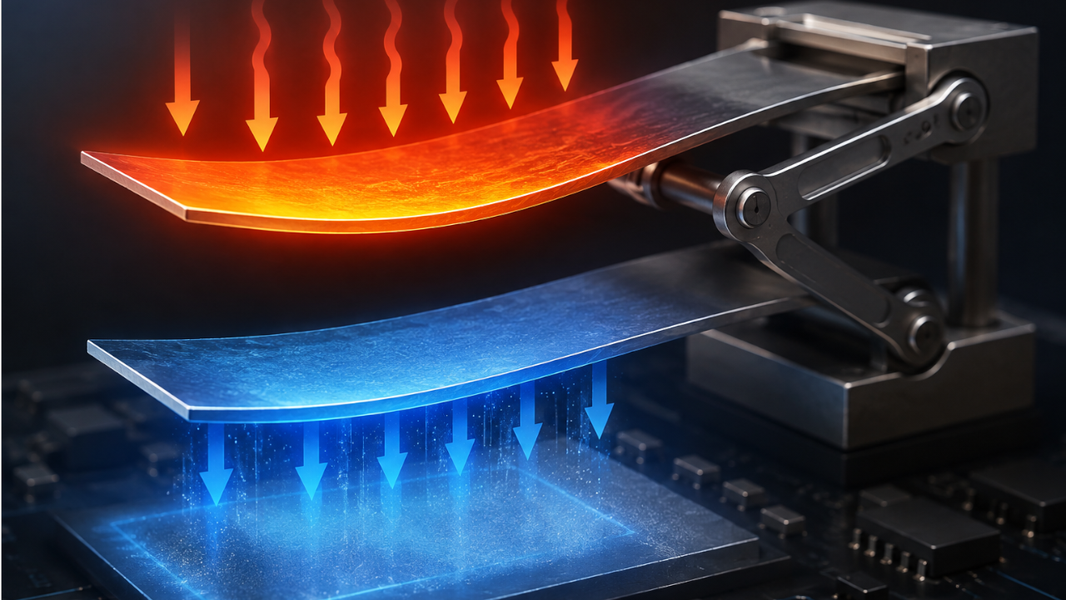
Instead of relying on conventional electromechanical compressors, which consume electricity and typically use chemical refrigerants, the new system eliminates these components altogether. It connects two ultra-thin metal strips made from a nickel-titanium alloy, an advanced material known for its ability to change and recover its shape and dimensions in response to changes in temperature or pressure.
The cooling mechanism relies on a materials-physics phenomenon known as elastocaloric cooling. The process operates through a continuous cycle.
During the first stage, waste heat is used to heat the first metal strip, causing it to contract. This contraction acts as a mechanical actuator, pulling on the second strip and causing it to stretch. As the second strip stretches, it temporarily releases heat, which is then dissipated into the surrounding environment.
In the second stage, the tension is released, allowing the second strip to relax and return to its natural state. At this precise moment, the material absorbs a significant amount of heat from the surface in contact with it — such as a computer processor or electronic chip — as it returns to its original structural state. This rapidly lowers the temperature of the contact surface and produces the desired cooling effect.
The actuator strip is just 22 micrometers thick, while the cooling strip measures 26.5 micrometers. Despite being thinner than a human hair, the actuator strip generates a mechanical pulling force more than 10 times greater than that of comparable commercial actuators.
The first prototype demonstrated promising results in laboratory experiments. When supplied with heat at 86°C (187°F), the system achieved a temperature reduction of 12.9°C (23.2°F) in the cooling material itself and a 4°C (7.2°F) reduction across the system as a whole. The system also demonstrated high reliability when operated using external heat sources reaching 130°C (266°F).
According to the researchers, the technology outperforms current integrated thermoelectric cooling systems in terms of efficiency, reaching up to 84% of the theoretical maximum efficiency.
The team is now working to scale up the cooling capacity by connecting multiple metal strips in parallel. Potential future applications include using waste heat generated by high-performance computer processors to cool electronic chips themselves, as well as recovering waste heat from electric vehicle motors to cool sensitive electronic circuits inside the vehicle.
If successfully scaled, the technology could provide cooling without imposing additional electrical loads, offering a promising approach to improving overall energy efficiency while making use of heat that would otherwise be wasted.
The study was published in Nature Energy.
Related Articles