DeepSeek and Huawei partner to build an alternative to Nvidia's ecosystem.
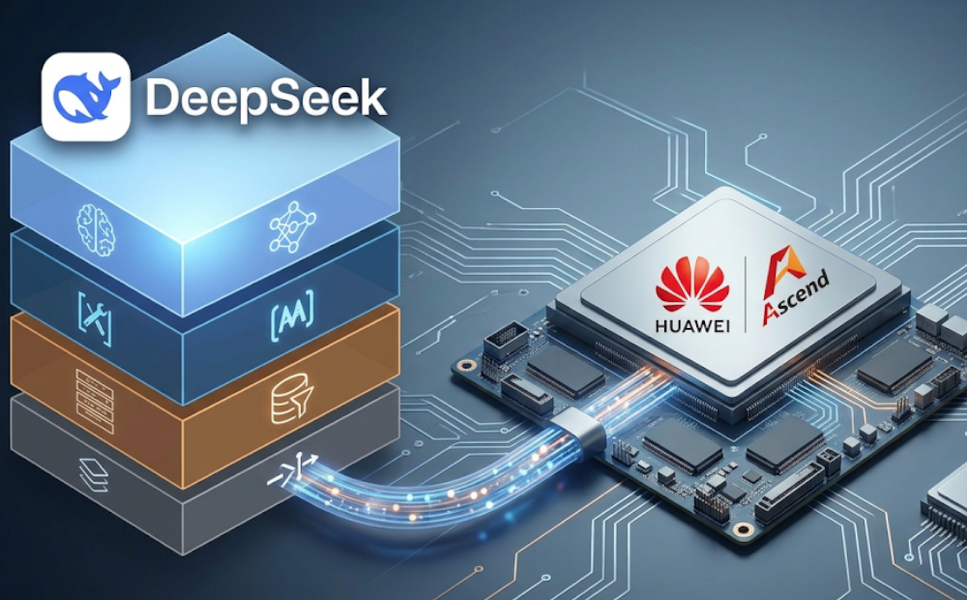
When a developer trains an AI model, the model ultimately needs to execute billions of calculations on specialized hardware, like Nvidia GPUs or Huawei's Ascend chips. However, the model doesn't interact directly with the silicon. Instead, it relies on software layers that translate its required operations into instructions the chip can execute efficiently.
These layers vary by company. Nvidia uses the CUDA ecosystem, which is more than just a programming language—it is a comprehensive suite of tools, libraries, compilers, and software that helps developers run calculations efficiently on its hardware. When a developer uses a framework like PyTorch to train a model, the calculations pass through these software layers before reaching the Nvidia chip. This deep integration is why CUDA has become a foundational pillar of Nvidia's ecosystem rather than a standalone developer tool.
Huawei has a different ecosystem for its Ascend chips, centered around the CANN platform and the Ascend C language, which allows developers to write operations tailored to the hardware's specific features. However, working directly at these low levels requires deep knowledge of the Ascend architecture and how data and compute are structured within it.
To bridge this gap, DeepSeek is partnering with Huawei to develop a software layer that helps developers use Ascend chips more efficiently. This includes compute and communication libraries, as well as specialized software kernels designed to maximize hardware capabilities. These libraries serve a similar purpose to the ones developers rely on in Nvidia's ecosystem, but they are specifically optimized for the Ascend architecture. This allows developers to tap into the chips' full power using pre-built software instead of writing every operation from scratch.
DeepSeek also utilizes TileLang, an open-source programming language that operates at a higher abstraction level than the tools interacting directly with the chip. TileLang is versatile and can be used across various chip architectures, not just Ascend.
This higher-level approach means developers don't need to master the granular details of every chip type. Instead of rewriting a calculation from scratch for each architecture, a large portion of the code can be written abstractly, leaving the compiler to adapt it to the specific hardware. This simplifies porting software between architectures and drastically reduces the time and effort required to leverage different chips.
Through this collaboration, Huawei and DeepSeek are leveraging their software expertise to build a complete ecosystem around Ascend chips, making it easier for developers to run models efficiently and accelerating broader adoption. The partnership also extends beyond single-chip optimization to cluster-level computing. According to Reuters, the companies jointly developed a Supernode configuration based on 128 Ascend 950 chips, optimizing computation, communication, and data exchange across the hardware. This is critical for training massive AI models, where performance relies not only on individual chip speed but on the ability of hundreds of chips to work together and exchange massive datasets seamlessly.
Ultimately, the impact of this collaboration goes beyond simply boosting Ascend chip performance—it aims to build an ecosystem that makes the hardware highly practical for widespread use. As the surrounding software matures and deploying models becomes easier, one of the biggest barriers to adoption will be removed.
If Huawei can deliver a software ecosystem that attracts developers and enables them to easily harness the power of Ascend, it will take a massive step toward building a dominant, integrated hardware ecosystem—just as Nvidia did.
Related Articles

What is an AI PC ?
What are TPUs: Google’s Powerhouse for AI?

How AI Pin works