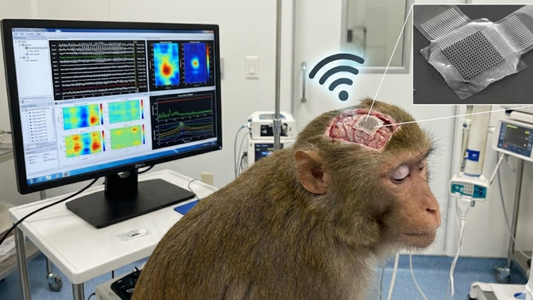
A team of researchers at Columbia and Stanford Universities has successfully developed a brain-computer interface that transcends traditional concepts of implanted brain chips. They dubbed it the “Biological Interface System for the Cortex,” abbreviated as (BISC).
This brain chip is not merely a conventional device, but an ultra-thin integrated silicon chip no more than 50 micrometers thick (thinner than a human hair), with a total volume of just 3 cubic millimeters. These specifications make it extremely flexible and capable of bending to fit the topography of the brain’s surface, resting on it with a softness resembling that of a wet piece of tissue paper, without the need to penetrate sensitive brain tissue or cause damage as happens with other brain chips.
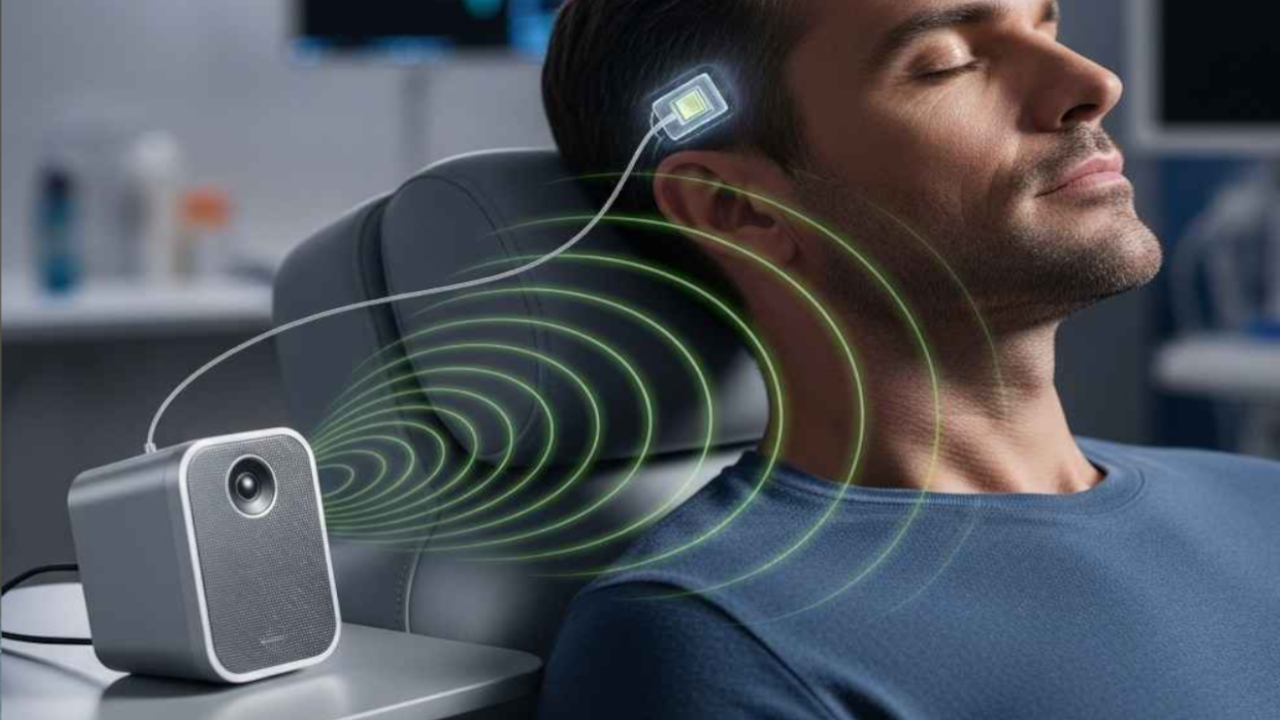
The BISC system consists of three main parts working in perfect harmony: the brain implant itself, an external relay station, and advanced software for analysis.
The chip is manufactured using (CMOS) technology used in making computer processors, which facilitated the manufacturing process and enabled scientists to integrate 65,536 micro-electrodes distributed over a small area. These electrodes touch the cerebral cortex and do not penetrate it, making it safer. They are directly connected to signal processing circuits, amplifiers, data converters, power circuits, and a wireless transmitter, all integrated into that small piece of silicon.
The chip operates by capturing electrical signals through these electrodes, where it can activate 1,024 channels simultaneously to select a specific part of the information for processing. It then digitizes and compresses it internally before sending it wirelessly via an ultra-wideband radio link at a stunning data transfer speed reaching 100 Mbps to the “relay station” worn by the patient outside their body. In turn, this station powers the chip wirelessly and acts as a bridge to transfer data to computers for analysis and decoding using artificial intelligence algorithms.
The fundamental difference between the BISC technology and its predecessors of brain chips lies in the radical elimination of the “metal box” and wires; while current traditional systems rely on implanting huge electronic cases in the chest or skull and passing long wires through the neck or head to reach the brain, BISC has dispensed with all that by integrating all electronic components inside the implanted chip itself.
This innovation means reducing the device size by more than a thousand times compared to traditional devices, and eliminating the need for wires that penetrate the skin or bone. This significantly reduces the risks of infection, inflammation, and surgical complications, making the entire process less invasive and safer for the patient in the long run.
This technology has moved beyond the theoretical design stage and proved its effectiveness in practical reality, having undergone extensive long-term testing on animal models including pigs and monkeys. It demonstrated stability in recording and high signal quality that lasted for weeks and months.
The team also moved a step forward by collaborating with New York-Presbyterian Hospital to begin initial human trials, which are currently being conducted through short-term recordings during surgical operations for patients to ensure the device’s safety and efficiency in a real operating environment, along with founding the company “Kampto Neurotech” to pave the way toward producing a certified commercial version for permanent therapeutic use.
When comparing BISC with the famous “Neuralink” chip owned by Elon Musk, a clear philosophical and engineering difference appears between the two approaches; while Neuralink relies on a “penetrating” technology that implants fine threads inside brain tissue to reach individual neurons, BISC adopts a “surface” approach by placing the chip on top of the cerebral cortex without implanting anything in the neural tissue. This difference makes BISC theoretically safer and less likely to cause tissue scarring or violent immune responses that might occur as a result of implanting foreign objects inside the brain.
Although Neuralink might provide higher precision in monitoring a single cell, BISC compensates for that with the massive density of electrodes and the ability to cover wider areas of the brain with very high spatiotemporal resolution, making it a fierce competitor and a promising medical option for treating conditions such as epilepsy, paralysis, and restoring vision in the near future.