Singapore Unveils the World’s First Biological Server Rack Powered by 16 Million Living Human Brain Cells
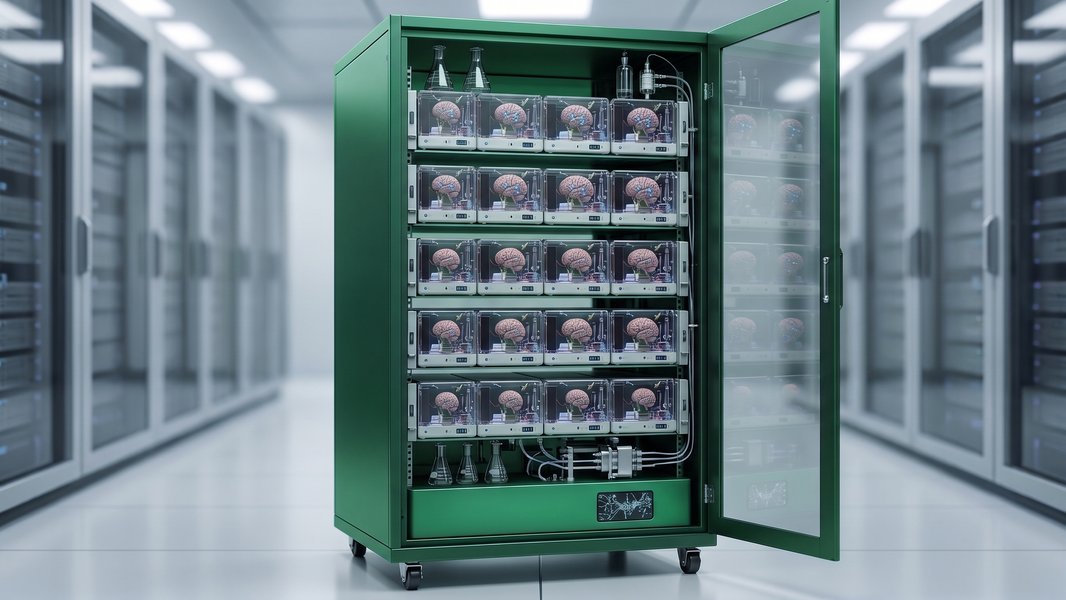
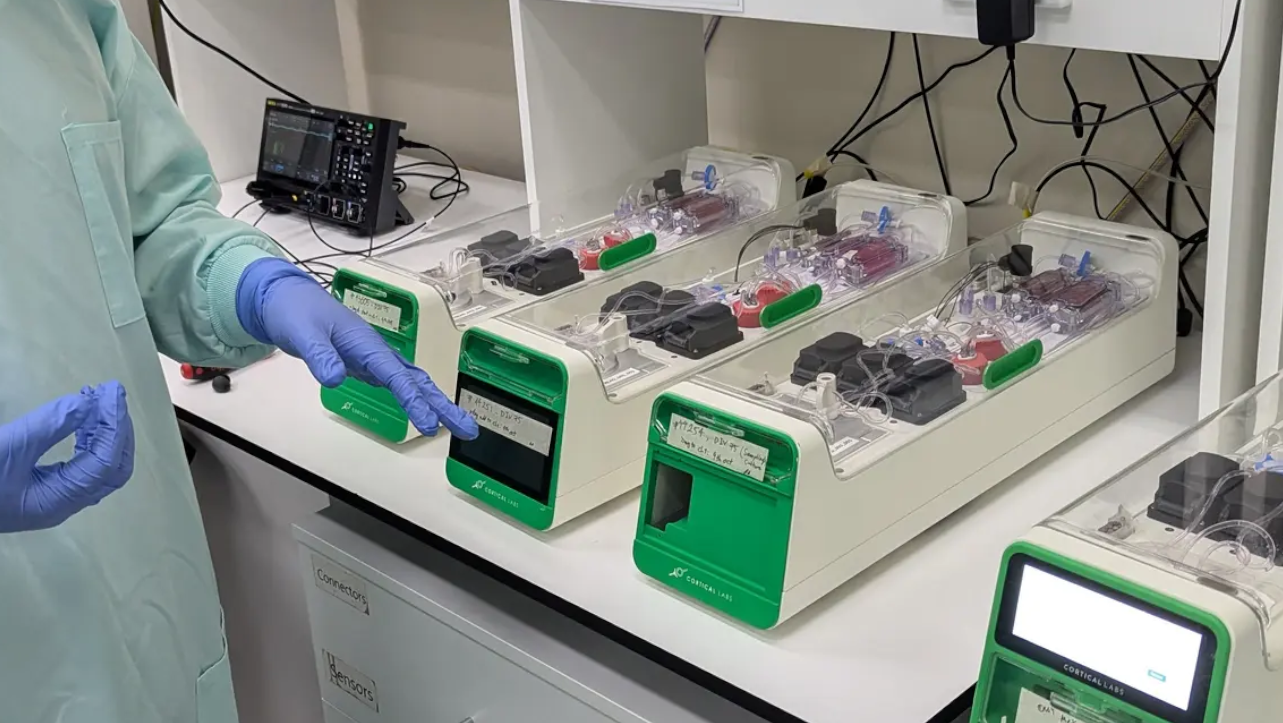
Researchers at the National University of Singapore (NUS) have unveiled what is being described as the world’s first biological server rack built around living human neurons instead of conventional silicon processors. The system consists of 20 CL1 biological computers developed by Australian biotech company Cortical Labs, the first commercial biological computing platform designed to run software directly on living neural tissue.
Each CL1 unit contains around 800,000 human neurons grown from stem cells, bringing the total to approximately 16 million living neurons housed within a self-contained server rack.
How Living Neurons Become a Computer
The system combines living neurons with silicon electronics through microelectrode arrays that serve as two-way communication channels. These microscopic electrodes deliver electrical pulses that represent digital information, while simultaneously recording the neurons’ responses as they process that information.
At the center of this interaction is biOS, Cortical Labs’ custom-built Biological Intelligence Operating System. Rather than replacing conventional software, biOS acts as a bridge between living neural activity and digital computing. It allows programmers to interact with neural tissue as though it were a programmable processing unit by translating neural signals into data that applications can understand and sending precisely timed stimulation patterns back to the cells.
This creates a complete computing environment in which living neurons become an active part of the processing system.
Training Neurons Without Backpropagation
Unlike traditional artificial intelligence, these living neural networks are not trained using backpropagation. Instead, they rely on the Free Energy Principle, a neuroscience framework proposing that neurons naturally seek to minimize surprise by making their environment more predictable.
When the neurons produce the desired behavior, the system rewards them with stable, predictable electrical patterns that reinforce successful activity. When they make mistakes, they receive irregular, chaotic signals that encourage the network to reorganize its synaptic connections in order to reduce uncertainty.
This natural process of neural adaptation allows the networks to learn rapidly while requiring relatively little training data.
Remarkable Energy Efficiency
One of the system’s most striking features is its energy efficiency. Each CL1 unit consumes only about 25 watts, meaning the entire 20-unit server rack operates at roughly 850 to 1,000 watts. For comparison, a single Nvidia H100, one of today’s most powerful AI GPUs, draws around 700 watts on its own.
The neurons remain viable for up to six months thanks to an integrated life-support system that maintains body temperature, circulates nutrients, balances oxygen and carbon dioxide, and removes metabolic waste.
Potential Applications
Although biological computing is still in its early stages, researchers believe it could open new possibilities across several fields.
Potential applications include humanoid robotics, where low-power adaptive learning is valuable, drug discovery and neurological disease research using human-derived neural tissue, and studies aimed at better understanding how the brain learns and adapts. Researchers also see promise in cybersecurity and fraud detection, where living neural networks may prove especially effective at recognizing complex, rapidly changing patterns that are difficult for conventional digital systems to handle.
While this technology is not intended to replace today’s silicon-based computers, it represents a significant step toward a new generation of biological computing systems, demonstrating how living neurons can be integrated into a server-rack-scale computing platform for research and future computing applications.